


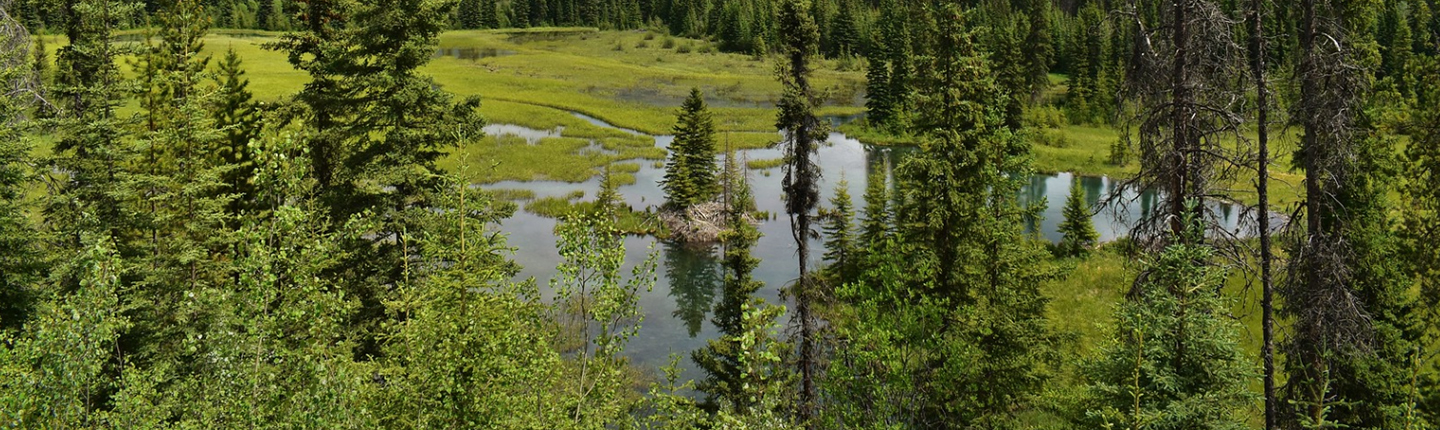
Wetland Conservation in Peace Country
This project will use GIS data to assess the health of wetlands that are close to roads. Wetlands with degraded health will be targeted for future restoration.
In the northern boreal mountains eco-region, the project will collect data for the Wetland Ecosystem Services Protocol, which is a tool that can be used by government, non-profits, and Indigenous Nations to support better wetland mitigation and protection.
Effectiveness monitoring and maintenance will also occur at past restoration sites, including McIntyre Lake, which was restored with FWCP funding in F25.
Update: Wetland assessment and restoration continues—42 WESPs completed
Seventeen wetland ecosystem services assessments (WESP) were completed and 42 wetland plots (all part of the Canadian National Wetlands Inventory) were completed, contributing to the wetland classification and inventory.
At the McIntyre Wetland Restoration Project site, the team assessed the effectiveness of beaver dam analogues (BDA) constructed last year.Early monitoring indicates increased surface water levels following BDA installations, suggesting improved water retention.
Engagement, collaboration, and knowledge sharing between the Kwadacha Nation, McLeod Lake Indian Band, the Tsay Keh Dene Nation,and the BCWF was an important part of this project.
Executive Summary
Commencing April 1, 2025, the BC Wildlife Federation (BCWF) worked toward fulfilling the commitments outlined in the FWCP proposal Wetland Conservation in Peace Country (PEA-F26-W-4273). Training and collaborative field activities were hosted in partnership with Kwadacha First Nation, Tsay Keh Dene First Nation (Chu Cho Environmental), and McLeod Lake Indian Band.
The training focused on enhancing wetland identification, inventory, restoration monitoring, and wetland health assessments with and for First Nation community members, Land Guardians, and Technicians. This work built on capacity and partnerships developed in previous years and contributed to the strengthening of long-term relationships.
Project activities included collecting calibration data for the Wetland Ecosystem Services Protocol (WESP), gathering wetland mapping data using the Canadian National Wetlands Inventory (CNWI), monitoring the McIntyre Wetland Restoration Project, and conducting Road Impact Wetland Health Assessments (RIWHA) to identify priority wetland sites for restoration. Within the FWCP Peace Region focal area, a total of 17 WESP assessments, 42 wetland mapping points, and 25 RIWHA assessments were completed. This marked the first year that WESP, CNWI, and RIWHA were initiated within the Northern Boreal Mountains ecoprovince.
Training and project delivery in these regions have resulted in lasting partnerships and future workshop and project opportunities, supporting continued capacity building and stewardship by local community members.
Project Results Summary
• Engaged a total of six community members.
• Trained six community and environmental monitors from Kwadacha First Nation (2), Tsay Keh Dene First Nation (2), and McLeod Lake Indian Band through hands-on field participation (2).
• Continued monitoring of the McIntyre Wetland Restoration Project, including the installation of two additional downstream structures.
• Established foundational relationships with partner Nations to support ongoing wetland conservation and restoration within their traditional territories.
Alignment with the Peace Region Riparian and Wetlands Action Plan
Implementation of the Wetland Ecosystem Services Protocol (WESP), wetland mapping (CNWI), McIntyre Wetland Restoration Project monitoring, and Road Impact Wetland Health Assessments (RIWHA) demonstrates strong alignment with the Peace Region Riparian and Wetlands Action Plan, addressing multiple key sub-objectives and actions:
Action #1: Prioritization of wetland and riparian habitats for conservation and/or enhancement
Wetland conservation was prioritized through the development and application of wetland mapping and assessment tools, alongside the evaluation of impacts and threats to wetland and riparian systems, in accordance with the Peace Region Riparian and Wetlands Action Plan (FWCP 2021). In 2025, 25 sites were field evaluated in the Williston Reservoir utilizing RIWHA. The average health score across all visited sites was 71%, placing them within the “Functioning but at Risk” category (healthy but with identified concerns). This suggests that while overall wetland condition was moderately high, several indicators show signs of stress or alteration. Based on the sites assessed no restoration candidates were proposed. Many exhibited impacts, and may have had potential if identified earlier, but the wetlands have adapted to the changes, and interventions now may not result in clear ecological gains.
Sub-Objective 1: Maintain and/or increase the resilience of riparian and wetland ecosystems
Water-level data was collected and analyzed to observe post-restoration hydrologic responses, including fluctuations in water levels, hydrologic gradients, and flow direction. The integrity and performance of the 17 beaver dam analogue (BDA) structures installed in October 2024 were assessed to confirm their ability to retain water and mitigate headcut erosion. Two additional BDAs were installed downstream in September 2025 to further enhance ecological resilience. These structures mimic natural beaver activity by improving water retention, moderating stream flows, and stabilizing channels.
Sub-Objective 2: Restore natural wetland hydrology
• Action #3: Strategic placement of BDAs restored more natural hydrological function by slowing surface water movement, promoting sediment deposition, and encouraging shallow groundwater recharge. These improvements are foundational to long-term wetland health and resilience.
Sub-Objective 4: Maximize population viability of priority riparian and wetland species
• Action #9 & #11: Incidental wildlife observations of black bears, moose, and amphibians suggests that these species are benefiting from the restoration site near McIntyre Lake through the safeguarding of wetland features such as shrub forage, and increase in amphibian pond breeding area.
Sub-Objective 6: Increase opportunities for community engagement and resource stewardship
Throughout 2025, members of Kwadacha First Nation, Tsay Keh Dene First Nation, and McLeod Lake Indian Band were engaged through training sessions and community consultations. These efforts fostered local stewardship and supported community-led conservation priorities within their traditional territories.