


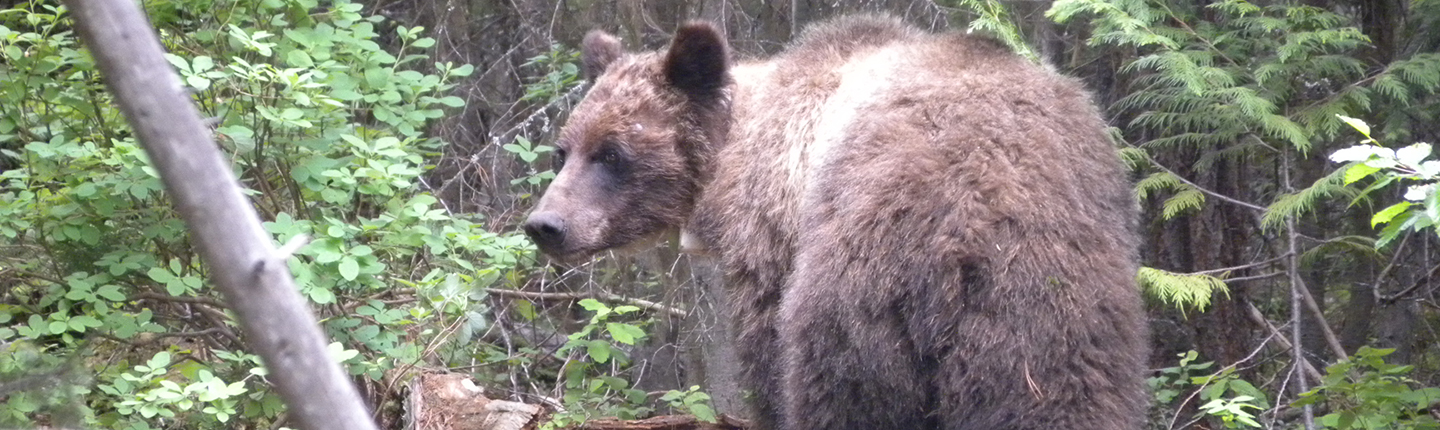
Understanding Grizzly Bear Habitat Use and Populations
This multi-year project will increase understanding of culturally significant and at-risk grizzly bear populations in Tsay Keh Dene Nation Territory. This year, the project will expand into the Ospika study area, east of the Williston Reservoir.
This project will identify grizzly bear movement corridors in the Territory through landscape connectivity modelling and camera trap stations, and investigate corridor demographics, diet, and health using hair snag stations.
The goal of this project is to increase understanding of local grizzly bear populations and identify movement corridors for protection.
Update: Grizzly bear monitoring fills data gaps
Using 50 paired camera sites, totalling 10,620 monitored days, the project team increased the understanding of local grizzly bear populations and movement corridors.
Site-specific detection rates reflected seasonal use by grizzly bears. Hair analyses confirmed use by seven individual grizzly bears and indicated recurring use of sites by bears.
In addition to grizzlies, other valued species, including caribou, moose, lynx, and several bird species, were also detected.
Executive Summary
The study is based on interweaving indigenous and western ways of knowing to achieve a more holistic understanding of how grizzly bears interact with the local landscape. The project aims are to: (1) identify key grizzly bear movement corridors using landscape connectivity modeling, TEK, and camera trap surveys; (2) analyze population demographics, diet, and health through genetic sampling; and (3) develop conservation recommendations to protect movement corridors and enhance habitat connectivity. This project directly aligns with FWCP Actions 1 and 13. Fieldwork for this project was conducted across three study areas within TKDN Core Territory that span a diverse range of ecosystems. Since initiating the study in 2022, we have deployed camera trap stations and hair snag sites to monitor bear movement and habitat use at 50 paired sites totalling 10,620 monitored days. In 2022 and 2023 there were no significant differences in species detection between corridor and reference sites. In 2024, corridor sites had greater detection rates for both grizzly bears and other species. We present several potential improvements to field methods for monitoring, future hair analyses, and development of management recommendations to help protect movement corridors valuable to grizzly bears and other species. We acknowledge that the involvement of TKDN community members and collaboration with local and provincial governmental departments have and continue to be essential to the project's success and will be critical to establish protected corridors and support ongoing conservation efforts.