


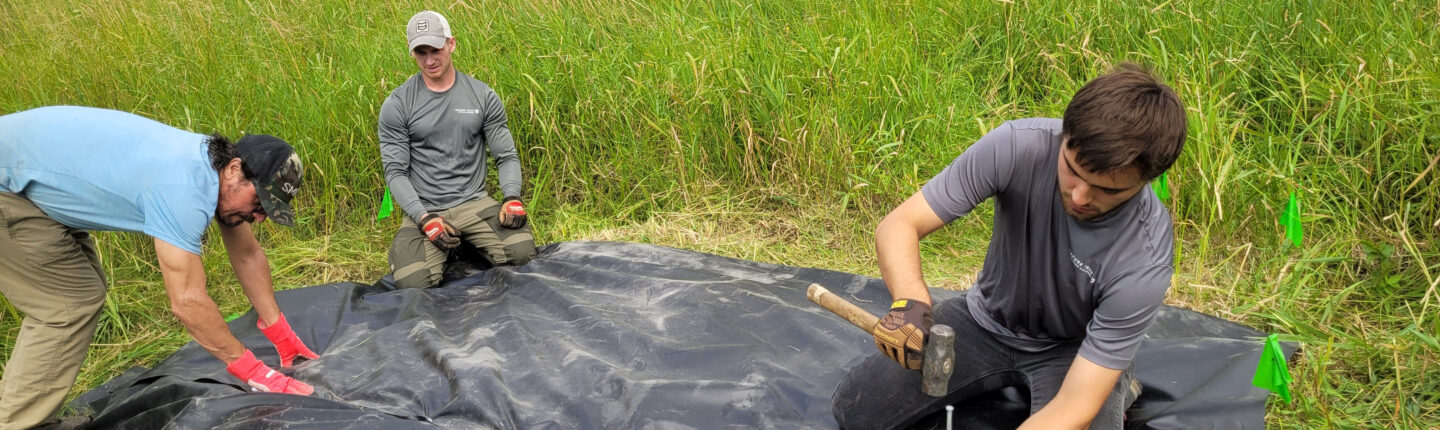
NTBC Land Stewardship Activities-Conservation Field Crew Program
This project supports conservation field crews to do stewardship and operational projects each year on conservation properties in the East and West Kootenay to maintain and enhance biodiversity and wildlife values.
This year, the project will continue to build on fostering closer collaboration with First Nations. Stewardship actions will focus on conservation properties acquired by Nature Trust with FWCP funding, including the Duncan-Lardeau Flats, Big Ranch, and the Hoodoos.
Executive Summary
In 2024-25, The Fish & Wildlife Compensation Program (FWCP) Columbia Board approved $39,100 to support The Nature Trust of British Columbia (NTBC)’s Conservation Field Crew (CFC) program, which annually employs those early in their conservation careers to implement important ‘on-the-ground’operations and maintenance-focused conservation work. The FWCP funding was leveraged and combined with other funders to make the project a success. The 2024-25 CFC work plan put a specific focus toward access management issues and the protection of conservation areas, identified in the FWCP’s Columbia Region Upland and Dryland Action Plan (COLUPD.ECO.HB.16.01 Access management issues-P1).Another priority in the 2024-25 field season was identifying areas for restoration, as identified in the Upland and Dryland Action Plan (COLUPD.ECO.RI.07.01 Identify candidate upland areas for ecosystem restoration-P1).
While preparing for the field season, NTBC faced staffing challenges greater than those encountered in past years. Multiple staff have transitioned out after working for the organization for several years,including two past crew leads, with notice received very close to the beginning of field season. Late hiring is challenging, as many seasonal job seekers secure work by late winter. The decision was made to hire a single Field Operations Coordinator for multi-year employment, in order to rebuild field crew capacity in a way that ensures staff are effectively supported in their roles. A change request detailing this adjustment was submitted and approved by FWCP. Learnings were applied to hiring for the 2025field season, with crew recruitment already completed for the upcoming field season.
Following a lengthy hiring process, a new Field Operations Coordinator began work in July 2024, and has been employed continuously since then. The Field Operations Coordinator (FOC) conducted valuable conservation field work and training during the 2024 season and built experience to enable them to lead the field crew in the upcoming season, the hiring of which they led and completed in early 2025. The FOC frequently worked independently, and therefore often focused on tasks which could be safely and effectively completed by one person. Work not appropriate to be completed alone was undertaken alongside other NTBC staff, contractors, or where possible, with First Nations partners.
With a smaller NTBC staff contingent, alongside goals to expand working relationships with local First Nations, an increased portion of FWC funding was allocated to supporting Indigenous participation in projects. This work involved ongoing, expanding, and new collaborative opportunities, and facilitated monitoring and enhancement activities which would not have been completed by NTBC staff alone.
The new staff member was able to participate in several important training and professional development opportunities and undertook a variety of work activities, all with a focus on land stewardship. Along with addressing specific FWCP Action Plans, there was a particular focus during2024-25 on the Hoodoos, Big Ranch, Arrow Lake, and Bull River Grassland Corridor conservation areas.Some of the FOC work activities included fence assessment/maintenance/repair, invasive species inventory/ removal, kiosk and signage installation, hand seeding, litter removal, vegetation plot monitoring, wildlife camera installation/monitoring, infrastructure inventory, work plan prioritizing, and other basic assessments and inventories. These activities were carried out on 25 NTBC and BC Ministry of Water, Land and Resource Stewardship (WLRS) conservation areas/complexes throughout the Kootenay Region. Several days were spent assisting subject matter experts with different projects, which also served as on-the-job training. The following report compiled by NTBC staff provides more details on the 2024-25 CFC Program.
The Nature Trust of British Columbia gratefully acknowledges the financial support of the Fish & Wildlife Compensation Program for its contribution to this component of the project.