


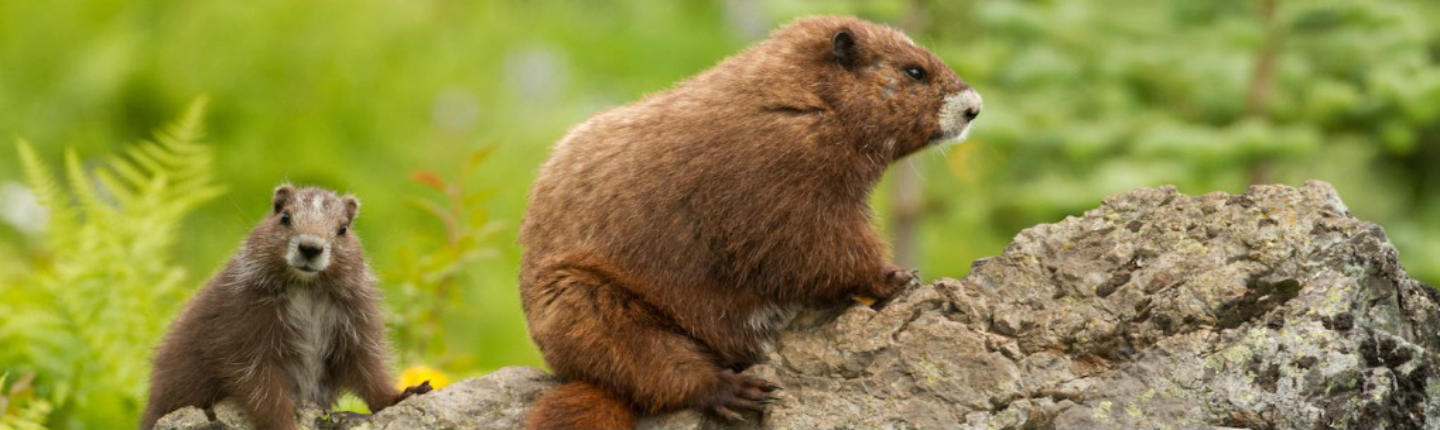
Translocating Vancouver Island Marmots to Strathcona Park 2025
The Vancouver Island marmot is an Endangered species that was extirpated from Strathcona Park in the Campbell and Puntledge watersheds in the 1990s.
This year, the project will translocate between two and 10 marmots into the Strathcona population. Timely, continued support will continue this species’ progress towards recovery.
Reintroduction efforts like these in the past four years have helped establish new marmot colonies.
Executive Summary
The endangered Vancouver Island marmot (Marmota vancouverensis, Swarth, 1911) is one of only five endemic land mammals in Canada (Nagorsen, 2004). The Vancouver Island marmot is recognized as an endangered species under the B.C. Wildlife Act and is on the B.C. Red List of species at risk. Nationally, it is listed under Schedule 1, Endangered, on the Species-at-Risk Act. Internationally, the International Union for Conservation of Nature (IUCN) lists the species as Critically Endangered. A recovery program for the marmot was launched in 1996, and 2025 was the 29th year of intensive recovery efforts.
During 2025, the Foundation conducted core field and conservation breeding activities intended to lead to achieving recovery goals for the species. Field work objectives were intended to (i) increase the number of marmots in the wild and protect the persistence of existing colonies, (ii) support wild reproduction, (iii) restore critical habitat, (iv) relocate marmots found in unsuitable habitat, and (v) monitor the wild population. The Wilder Institute/Calgary Zoo helped the Foundation to monitor marmots at several colonies while also piloting new technologies that can be used to collect field data on the Vancouver Island marmot. Data from their team have been incorporated into the results reported here.
Conservation breeding objectives were intended to (i) maintain a safeguard against potential catastrophic or stochastic events in the wild, (ii) act as a long-term genetic reservoir, (iii) refine appropriate management and husbandry techniques for the successful captive maintenance and propagation of Vancouver Island Marmots, (iv) assist directed research, and (v) provide sufficient numbers of individuals for release towards the eventual restoration of the wild population.
This year saw the highest overall wild population counts ever recorded in the Vancouver Island marmot, for the second year in a row. Approximately 420 marmots were observed in the wild by the end of the season, distributed across 37 colonies in two main regions and two extralimital areas. Twenty colonies produced 116 pups over 41 litters, the highest number of pups ever recorded. There were 45 mortalities documented in 2025. Survey effort was similar to the previous 2-year average at most colonies, with a slight shift in effort from Nanaimo Lakes to the Strathcona region.
In total, 41 marmots from the conservation breeding program and 14 marmots with some level of previous wild-living experience were released or translocated to augment 17 priority colonies. Twenty-nine feeders were installed at 19 colonies to improve the early season survival and reproductive potential of ~299 marmots. Forty-two marmots were trapped over the season and subsequently re-released or translocated for various reasons. Since 2003, the Conservation Breeding Program has resulted in the release of 726 captive-bred marmots out to the wild. Currently there are 124 marmots in the Conservation Breeding Program, including 36 potential breeding pairs for 2026.
This report presents the results from the 2025 season. It includes reports on activities aligning with the Campbell River Watershed Action Plan (CBR.UAD.HB.25.02 Implement priority species and habitat related conservation actions – Implement Recommended Actions from the Vancouver Island Marmot Recovery Strategy) and the Puntledge River Action Plan (PUN.UAD.HB.22.02 Implement priority species and habitat related conservation actions – Implement Recommended Actions from the Vancouver Island Marmot Recovery Strategy).