


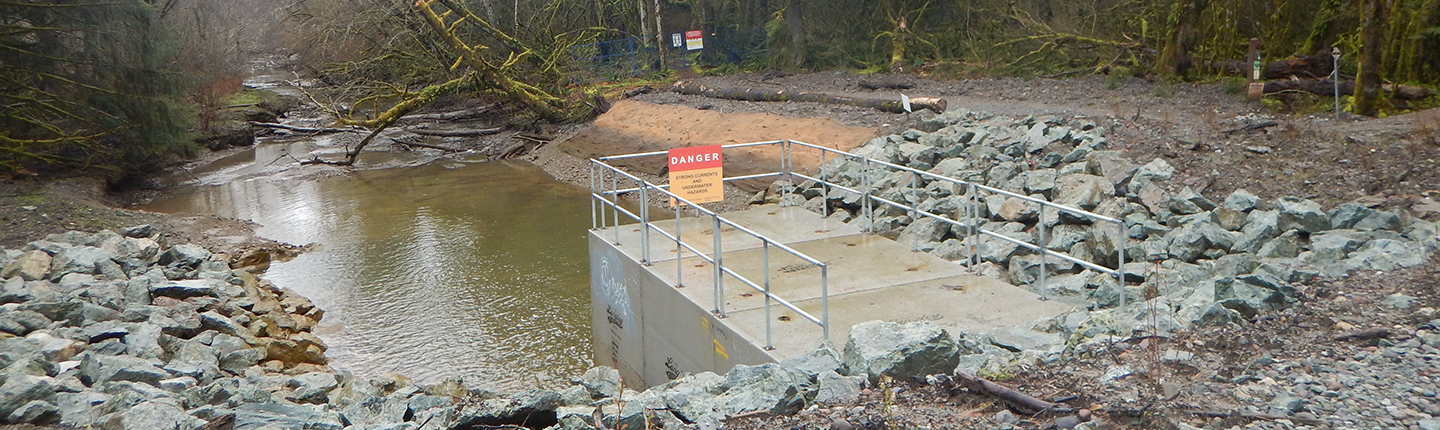
Central Squamish Estuary Salmon Passage Culvert
This project will restore connectivity for juvenile Chinook salmon between the Squamish River and the estuary.
An undersized culvert will be replaced with a larger box culvert that allows fish passage.
The project was developed in partnership with the Squamish Nation and Fisheries and Oceans Canada. It is part of long-term efforts to restore Chinook salmon populations in the Squamish River Estuary by reconnecting off-channel habitat with larger culverts and removing an industrial berm constructed in the 1970s.
Executive Summary
The focus of the project for this year was to upgrade and replace the second culvert, Culvert#2, along the Squamish Training Berm with a fish-passage friendly structure as part of the Central Estuary Restoration Project (CERP) Phase 1. The CERP was developed in 2018 in partnership with Fisheries and Oceans Canada (DFO) and Squamish Nation with the intention of improving tidal connectivity and water quality within the network of channels in the Squamish estuary and connections to the Squamish River. The focus was on improving accessibility for outmigrating juvenile Chinook salmon and other salmonids to access the inner estuary as part of DFO’s effort to increase Chinook salmon stocks. In addition, this work was also supported by Squamish Nation as part of efforts towards reconciliation. The CERP was planned in a three phased approach with Phase 1 to include upgrading and replacing culverts along the 5km Training Berm with fish-passage friendly culverts; Phase 2 involved modification of the lower 850m “spit” to restore river flow connectivity to the estuary; and Phase 3 was focused on improving water quality and tidal connectivity along the Little Bear Slough / Bridge Pond. Work this year focused on two areas within the Squamish estuary and included upgrading Culvert #2 along the Squamish Training Berm (CERP Phase 1) and developing plans to upgrade water flows along the Little Bear Slough / Bridge Pond (CERPPhase 3).
From 2019 to 2021 a portion of Phase 1 was realized with the replacement of two structures(Culvert #3 and #4) with fish-passage friendly box culverts. In September 2024 Culvert #1was replaced and, as part of the current fiscal and with the support of FWCP funding, in March/April 2025 Culvert #2, the final stage of Phase 1, was realized. From 2022 to 2023 Phase 2 was completed with the modification of 850m of the lower Spit and the removal of the three redundant culverts (Culverts #7, #8, and #9).
As in the previous year, the monitoring program continued incorporating emerging technologies including radio tracking technology, data loggers, and statistical analytics on movement of juvenile Chinook salmon, water quality characteristics including changes in temperature, conductivity, and dissolved oxygen, and changes and movement of sedimentation.